
Understanding electricity rates can help households and businesses manage their monthly expenses. The FESCO Electricity Tariff 2026 determines how electricity consumption and applicable charges contribute to the amount shown on a consumer’s bill. Your final bill may depend on your consumer category, units consumed, applicable tariff, taxes, and other adjustments.
Faisalabad Electric Supply Company (FESCO) serves consumers across its designated service areas in Punjab, Pakistan. Electricity rates and billing rules may change through official notifications, so checking the latest applicable tariff is important before estimating your monthly expenses.
In this guide, you will learn how FESCO electricity rates work, which factors affect your bill, how to understand different consumer categories, and where to verify official tariff information.
What Is FESCO Electricity Tariff 2026?
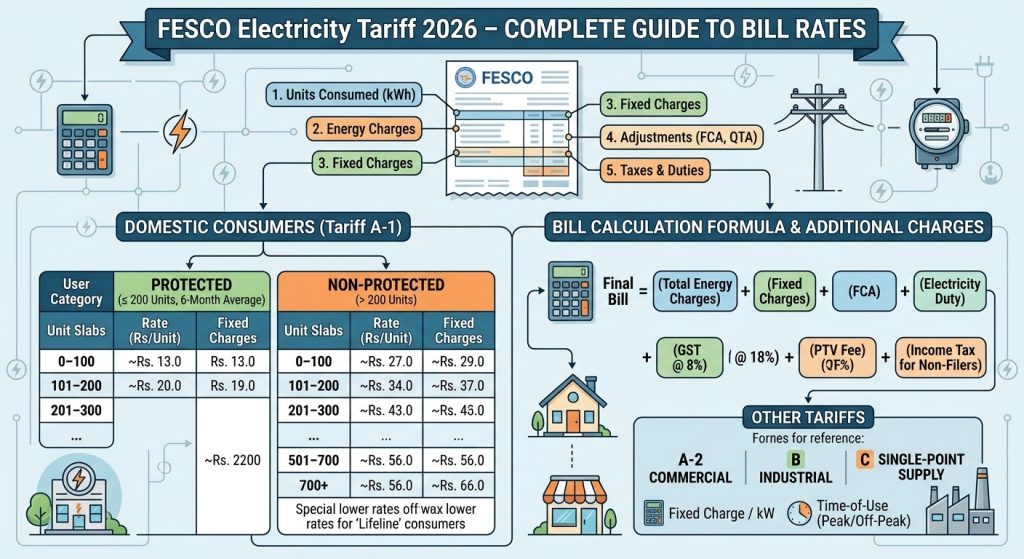
The FESCO Electricity Tariff 2026 refers to the applicable electricity pricing structure used for eligible FESCO consumers. It determines how electricity consumption is charged according to the relevant consumer category and approved tariff schedule.
Electricity tariffs are not necessarily identical for every connection. Domestic, commercial, industrial, and other consumers may fall under different categories with different billing rules.
Your electricity bill may include several components, such as:
- Electricity consumption charges
- Applicable fixed charges
- Government taxes and duties
- Fuel price adjustments, where applicable
- Quarterly tariff adjustments, where applicable
- Previous outstanding balances
- Late-payment charges, where applicable
The exact components depend on the applicable rules and your connection details. Therefore, the per-unit rate alone may not explain the total amount payable.
How to Check the Latest FESCO Electricity Rates
Electricity tariffs can change during the year. The safest approach is to check the latest official notifications rather than relying on an old rate chart.
Follow these steps:
- Visit the official NEPRA FESCO tariff page.
- Review the latest applicable tariff decisions and notifications.
- Identify the tariff category relevant to your connection.
- Check whether the document applies to your billing period.
- Review any applicable adjustments or government notifications.
NEPRA’s FESCO tariff page lists official tariff-related decisions and notifications, including 2026 updates. These documents are the appropriate starting point for verifying current rates.
You should also compare the information with the charges printed on your own electricity bill.
FESCO Domestic Electricity Tariff
Domestic consumers generally use electricity for household activities such as lighting, fans, refrigerators, air conditioning, and other appliances.
The amount payable depends on consumption and the tariff rules applicable to the connection. Certain domestic consumers may qualify for protected or other designated categories under the applicable policy.
When checking a domestic tariff, pay attention to:
- Consumer category
- Total units consumed
- Applicable per-unit charges
- Fixed charges, if applicable
- Taxes and other adjustments
- Any applicable minimum charges
Do not assume that every household pays the same rate. The applicable category and billing rules can affect the final amount.
FESCO Protected and Non-Protected Consumers
Electricity bills may distinguish between protected and non-protected domestic consumers under the applicable tariff policy.
Eligibility depends on the rules in force, which may include consumption-related criteria and other specified conditions. Simply using fewer units in one month does not necessarily establish eligibility in every situation.
If you are unsure which category applies to your connection, check the consumer information on your bill and consult the latest official tariff schedule.
Understanding your category is important because it can affect how the electricity charges are calculated.
FESCO Commercial and Industrial Tariff
Commercial and industrial connections may have different tariff structures from domestic connections.
Commercial consumers can include shops, offices, and other business premises. Industrial consumers generally fall under the relevant industrial tariff category based on their connection and approved classification.
Depending on the category, billing may involve:
- Energy charges based on units consumed
- Fixed charges or demand-related charges
- Time-of-use rates, where applicable
- Applicable taxes and adjustments
Consumers with time-of-use meters should review peak and off-peak consumption separately. The applicable rate and billing rules should be verified using the official tariff schedule for the relevant connection.
How FESCO Calculates Your Electricity Bill
Your electricity bill is generally calculated using the recorded electricity consumption and the charges applicable to your consumer category.
For example, if a household consumes more electricity during a billing cycle, its consumption charges may increase. The final bill can also change because of applicable fixed charges, taxes, or adjustments.
A simplified illustration is:
Electricity consumption charges = Units consumed × Applicable rate per unit
This formula explains the basic relationship between units and energy charges. It does not represent the complete bill calculation because actual bills may include multiple rates, fixed charges, taxes, and adjustments.
For example, a consumer who uses additional electricity may see higher consumption charges. However, the final payable amount cannot be calculated accurately without knowing the applicable tariff category and other bill components.
Why Is Your FESCO Electricity Bill Higher?
If your bill has increased unexpectedly, the tariff rate may not be the only reason.
Common causes include:
- Higher electricity consumption: Air conditioners, heaters, pumps, and other appliances can increase monthly units.
- Tariff changes: An official revision may affect the applicable charges.
- Fuel price adjustments: Applicable adjustments can affect the bill.
- Quarterly adjustments: Changes under the relevant tariff framework may influence charges.
- Previous unpaid amounts: Outstanding balances may be included.
- Taxes and duties: Applicable government charges contribute to the payable amount.
- Meter-reading issues: Incorrect readings should be investigated if the recorded units appear inconsistent.
Compare the units, meter readings, and itemized charges on your current and previous bills before concluding that the tariff has caused the increase.
How to Check Your FESCO Bill Online
Checking your bill online allows you to review available billing information without having to locate a paper copy.
Follow these steps:
- Keep your FESCO reference number available.
- Open a reliable online bill-checking service.
- Enter the reference number carefully.
- Review the displayed bill details and payable amount.
- Save or download the bill if the service offers that option.
You can use our FESCO Bill Online service to check available electricity bill information.
Remember that a bill-checking website does not independently determine official tariff policy. For disputes about charges or category classification, consult FESCO through its authorized customer service channels.
How to Reduce Your Electricity Bill
Although tariff rates are determined under the applicable policy, consumers can manage their usage to help control electricity expenses.
Use High-Power Appliances Carefully
Air conditioners, electric heaters, and water heaters can consume significant electricity. Avoid unnecessary use and follow the manufacturer’s energy-efficiency recommendations.
Switch to LED Lighting
LED bulbs generally consume less electricity than traditional incandescent bulbs for comparable lighting output.
Switch Off Unused Appliances
Turn off lights, fans, and appliances when they are not needed.
Monitor Monthly Consumption
Compare the units consumed each month. Tracking usage can help you identify unusual increases and make better decisions about electricity use.
Check Your Meter Reading
Compare the current reading printed on your bill with the meter display when possible. If a discrepancy remains unexplained, contact FESCO for verification.
Where to Find Official FESCO Tariff Updates
For accurate tariff information, use official regulatory documents rather than relying exclusively on social media posts or outdated rate charts.
The NEPRA FESCO tariff page provides tariff-related decisions and notifications.
Before using a rate table to estimate your bill, confirm its effective date, consumer category, and any subsequent notifications that may have changed the applicable charges.
This is especially important when checking rates for a particular month in 2026, because an earlier tariff schedule may no longer reflect the rules applicable to a later billing period.
Frequently Asked Questions
Are FESCO electricity rates the same for every consumer?
No. Applicable rates can vary by consumer category and tariff structure. Check the official schedule relevant to your connection.
Can FESCO electricity rates change during 2026?
Yes. Official tariff decisions, notifications, and applicable adjustments may affect charges during the year. Always verify the schedule for the relevant billing period.
Does the per-unit rate equal the total bill?
No. The final amount may include fixed charges, taxes, adjustments, and outstanding balances in addition to consumption charges.
How can I check my FESCO bill amount?
Use your reference number with a reliable bill-checking service, such as FESCO Bill Online, to review the available bill information.
What should I do if my bill seems incorrect?
Compare the units, meter readings, tariff category, and itemized charges. Keep your bill and supporting evidence, then contact FESCO through its authorized customer service channel if the discrepancy remains unresolved.
Final Thoughts
The FESCO Electricity Tariff 2026 helps determine how electricity consumption is charged for different consumer categories. However, the final amount payable may include several other components, so checking only the per-unit rate is not enough to understand your bill fully.
Review your consumer category, units consumed, applicable charges, and any adjustments shown on the bill. For the latest official rates, consult NEPRA’s FESCO tariff page and confirm which schedule applies to your billing period.
Keeping track of electricity usage and reviewing your bill regularly can help you understand your charges, identify unusual changes, and manage household or business electricity expenses more effectively.