
Knowing your FESCO Bill Reading Date 2026 can help you understand your monthly electricity consumption, billing period, and the difference between your previous and current meter readings. Many consumers see several dates on their electricity bill and may be unsure which date represents the actual meter reading.
The Reading Date is specifically the date on which the meter reading is taken. FESCO’s consumer-service documentation distinguishes the Reading Date from the Billing Month, Issue Date, and Due Date. It also identifies the present meter reading as the reading taken on the reading date and the previous meter reading as the reading taken on the previous month’s reading date.
This guide explains how to find your reading date, understand the different dates on your FESCO bill, and use the reading date to review your monthly electricity consumption.
What Is the FESCO Bill Reading Date 2026?
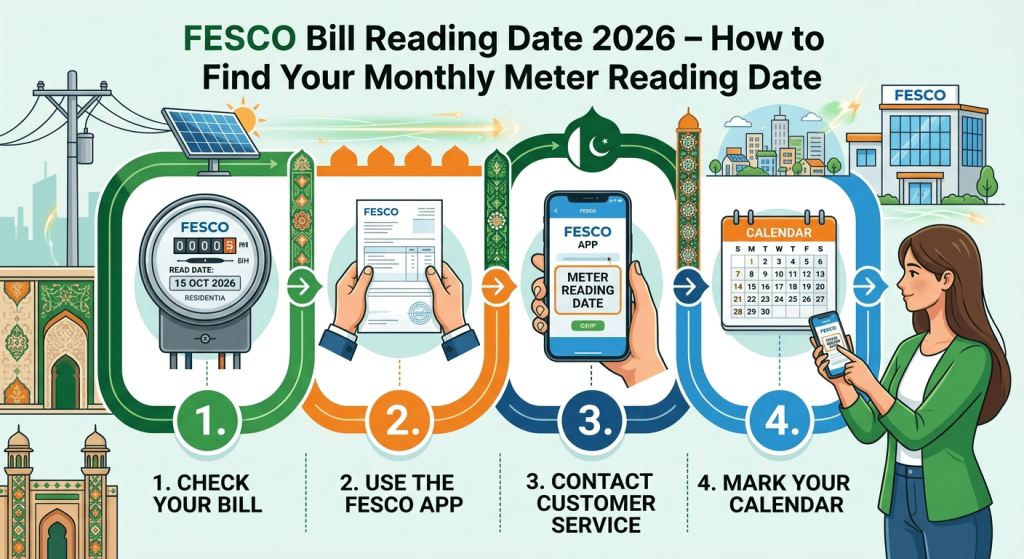
The FESCO Bill Reading Date 2026 is the date when your electricity meter reading is recorded for the billing cycle.
It is important because your current meter reading is connected to this date. Your bill also contains a previous meter reading, which comes from the previous month’s reading date. The difference between the two readings helps determine the electricity units consumed during the billing period.
For example:
| Bill Information | Example |
|---|---|
| Previous Reading | 15,200 |
| Present Reading | 15,475 |
| Reading Date | 05-10-2026 |
| Units Consumed | 275 |
In this example:
15,475 − 15,200 = 275 units
Where to Find the FESCO Bill Reading Date
Your FESCO electricity bill contains several important dates. To find the reading date, look for the field labeled:
Reading Date
Depending on the bill format, you may also see:
- Billing Month
- Reading Date
- Issue Date
- Due Date
- Previous Reading
- Present Reading
Do not confuse these dates because each one serves a different purpose.
FESCO’s consumer-service documentation specifically defines the Reading Date as the date on which the meter reading is taken.
FESCO Bill Reading Date 2026 vs Issue Date
The Reading Date and Issue Date are not necessarily the same.
Reading Date
This is when the meter reading is taken.
Issue Date
This is when the electricity bill is issued.
For example:
| Date Type | Example |
|---|---|
| Reading Date | 05 October 2026 |
| Issue Date | 08 October 2026 |
| Due Date | 20 October 2026 |
The actual dates on your bill can be different.
Understanding this difference is useful when checking whether the bill’s consumption period matches your meter readings.
FESCO Bill Reading Date 2026 and Meter Units
The reading date is closely related to your electricity consumption.
Your bill normally provides a present meter reading and a previous meter reading. FESCO documentation describes the present meter reading as the reading taken on the reading date, while the previous meter reading is the reading taken on the previous month’s reading date.
The basic calculation is:
Current Reading − Previous Reading = Units Consumed
For example:
12,850 − 12,500 = 350 units
Therefore, 350 units were consumed between the relevant meter readings.
How to Check Your Monthly FESCO Reading Date
You can check your reading date by following these simple steps.
Step 1: Get Your Latest FESCO Bill
Take your latest electricity bill and keep it available for reference.
Step 2: Locate the Bill Information Section
Look near the consumer and billing information displayed on the bill.
Step 3: Find “Reading Date”
Search for the field labeled Reading Date.
Step 4: Check Present Reading
Look at the present meter reading associated with that billing cycle.
Step 5: Compare With Previous Reading
Check the previous reading and compare it with the current reading.
This allows you to understand both the date and consumption associated with your monthly billing cycle.
Why Is the FESCO Bill Reading Date Important?
The reading date is useful for several reasons.
1. Understanding Your Billing Period
It helps you understand when your electricity consumption was measured.
2. Checking Meter Readings
You can compare the reading printed on the bill with your actual meter display.
3. Understanding Units
Comparing the present and previous readings helps you understand how your monthly units were determined.
4. Identifying Unusual Consumption
If your units suddenly increase, checking the reading dates and meter readings can help you investigate the difference.
5. Comparing Monthly Bills
Keeping your reading dates and units recorded can make it easier to compare consumption between billing cycles.
How to Compare Your FESCO Meter Reading With Your Bill
If you want to verify your bill, you can compare the meter’s displayed reading with the present reading printed on your bill.
A simple process is:
- Check the Reading Date on your bill.
- Check the Present Meter Reading.
- Look at your physical electricity meter.
- Compare the displayed reading with the bill.
- Review the previous reading and total units.
Remember that readings may not be checked at exactly the same moment you inspect the meter, so a small difference can be possible if electricity has been consumed after the official reading.
What Is the Difference Between Reading Date and Billing Month?
The Billing Month identifies the month for which the bill is issued, while the Reading Date identifies when the meter reading was taken.
FESCO’s consumer-service documentation separately defines the Billing Month and Reading Date.
For example, a bill could show:
Billing Month: October 2026
Reading Date: 05 October 2026
These are different pieces of information and should not be treated as the same thing.
Reading Date vs Previous Reading Date
Your bill can contain both a current and previous meter reading.
The current reading is associated with the current reading date, while the previous reading relates to the previous month’s reading date. This creates the basis for calculating consumption for the billing period.
For example:
| Item | Example |
|---|---|
| Previous Reading | 9,800 |
| Current Reading | 10,050 |
| Units | 250 |
| Current Reading Date | 05 Oct 2026 |
Calculation:
10,050 − 9,800 = 250 units
What If Your FESCO Reading Date Changes?
Your reading date may not always appear on exactly the same calendar day every month.
A change in the reading date can affect the number of days covered by a particular billing period. Therefore, when comparing two bills, it is useful to consider both:
- Total units
- Number of days between readings
For example, if one billing period covers 30 days and another covers 34 days, comparing only the total units may not give you the complete picture.
How to Calculate Average Daily Electricity Usage
You can use your units and billing-period length to estimate average daily consumption.
The basic formula is:
Average Daily Usage = Total Units ÷ Number of Days
For example:
300 units ÷ 30 days = 10 units per day
This can help you compare your electricity consumption across different billing periods.
What If the Reading on Your Bill Looks Incorrect?
If the reading printed on your FESCO bill appears inconsistent with your meter, first check:
- Meter number
- Reading date
- Previous reading
- Present reading
- Billing period
- Total units
Take note of the information before contacting the relevant FESCO consumer-service channel for clarification.
Do not assume that every difference is a billing error because your physical meter may have continued recording consumption after the official reading was taken.
How Reading Date Helps With High Electricity Bills
If your bill is unexpectedly high, the reading date can help you investigate the situation.
First compare:
Previous Reading → Current Reading → Total Units
Then consider:
- Was the billing period longer?
- Did you use more appliances?
- Was air conditioning used more frequently?
- Did your household consumption increase?
- Does the present meter reading appear reasonable?
This process can help you understand whether the higher bill is associated with increased consumption or other billing components.
Frequently Asked Questions
Official FESCO Bill Reading Resources
For accurate electricity billing information, meter reading details, and consumer services, you can use the official FESCO and PITC resources below:
- FESCO Official Website – Access official FESCO information, consumer services, and electricity-related updates.
- FESCO Online Bill Portal – Check your available FESCO electricity bill and review important billing information.
- FESCO Information Portal – Explore official FESCO information and consumer-related resources.
What is the FESCO Bill Reading Date 2026?
It is the date on which the electricity meter reading is taken for the relevant billing cycle.
Where can I find the reading date on my FESCO bill?
Look for the field labeled Reading Date in the billing information section of your electricity bill.
Is the reading date the same as the issue date?
No. The reading date indicates when the meter reading was taken, while the issue date indicates when the bill was issued.
Does the reading date affect electricity units?
The reading date identifies when the meter reading is recorded. Comparing the present reading with the previous reading helps determine the consumption for the billing period.
Can I compare my meter reading with the bill?
Yes. You can compare the present meter reading printed on your bill with the reading displayed on your physical electricity meter, while considering when each reading was taken.
Why should I keep track of my reading date?
Keeping track of your reading date can help you understand billing periods, compare monthly consumption, and investigate unusual changes in electricity units.
Final Words
The FESCO Bill Reading Date 2026 is an important part of your electricity bill because it identifies when your meter reading was taken. Understanding this date makes it easier to distinguish the reading date from the billing month, issue date, and due date.
By checking the Reading Date, Present Meter Reading, and Previous Meter Reading together, you can better understand your monthly electricity consumption and verify the information shown on your FESCO bill.